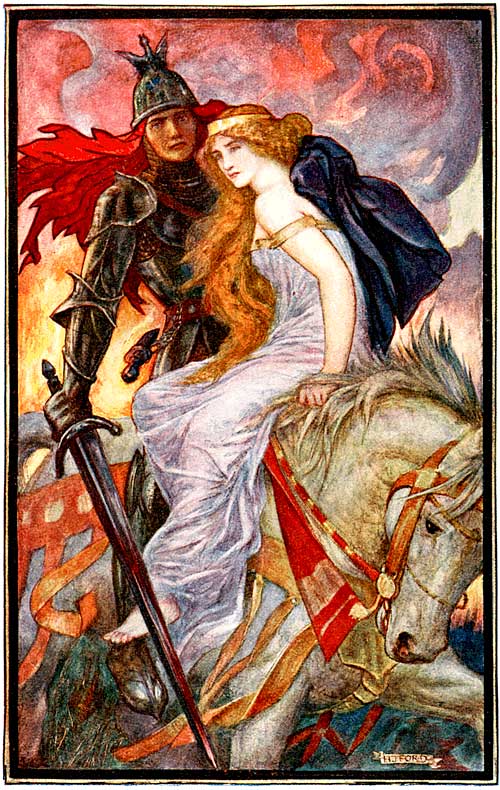
One of the things that always bothers me is any production of
Camelot in which Guenevere is played all sweet and virginal, or in other words, like Julie Andrews played her in the original production. The truth is that Guenevere can be a real bitch from time to time, and I think that's what's most interesting about her -- and what directors and actors miss most often. Without that, the story is far less interesting.
In many cases, original Broadway performances are reliable guides to what the writers wanted.
But not always. And not in this case. Andrews had a great voice in her youth, and genuine stage presence, but she was never a very good or very nuanced actor.
Guenevere, as she is written by Alan Jay Lerner, is rebellious, immature (at least in Act I), horny, and
blood-thirsty! Maybe she's just a product of her times, but she loves violence (see her song, "Then You May Take Me to the Fair"); and her immaturity and restlessness will lead to a lot of needless destruction.
Guenevere herself is Arthur's great tragic flaw.
Julie Andrews ruined the character with her bland, sexless original performance on Broadway, and more significantly, on the original cast recording. Vanessa Redgrave understood the character much more fully in her film performance, but she was such a mediocre singer, it's hard to get through her songs. Compare
Andrews' and
Redgrave's opposite approaches to "The Lusty Month of May." Redgrave (with the help of more languorous orchestrations) really enjoys the words
lusty and
depraved, and in her hands, it's a song about fucking. In Andrews' rendition, it's just polite double entendre.
In her first appearance in the show, Guenevere tells us in her "I Am" song that she is a trouble-maker. She
wants men to fight over her. She
wants them to kill each other over her. How can we be surprised when everything blows up in Act II?
Camelot's first two songs introduce two of our three leads, and both as complete neurotics, totally ill-equipped to be married. Of course their marriage will fail. We see in these two opening numbers that they are very immature. Then again, Arthur is only 25 and Guenevere only 17 when they meet.
A close look at the lyric of "Simple Joys of Maidenhood" tells us so much about Guenevere. Alan Jay Lerner has packed so much information into this song, all the while surprising us with punch line after punch line.
Guenevere starts the song by calling St. Genevieve, apparently her personal patron saint. But Guenevere has to remind the saint who she is; Guenevere doesn't pray a lot. Yet only a couple lines later, she's purporting to be so devout. Right off the bat, we see that she's a liar. She says she's always been a "lamb," but we'll soon see that's not true either. She lets her anger take over and she rages at St. Genevieve, complaining about the details of her current situation, and finally -- and hilariously -- threatening to find another saint to pray to.
St. Genevieve, St. Genevieve!
It's Guenevere!
Remember me?
St. Genevieve, St. Genevieve!
I'm over here
Beneath this tree...
You know how faithful and devout I am,
You must admit I've always been a lamb,
But Genevieve, St. Genevieve --
I won't obey you anymore.
You've gone a bit too far!
I won't be bid and bargained for
Like beads at a bazaar.
St. Genevieve, I've run away,
Eluded them and fled,
And from now on, I intend to pray
To someone else instead!
It is interesting to note Guenevere's 20th century objections to being medievally objectified. But then Guenevere decides maybe offense is a bad tack to take. If she wants rescue, she'd better be nicer to her patron saint...
Oh Genevieve, St. Genevieve,
Where were you when my youth was sold?
Dear Genevieve, sweet Genevieve,
Shan't I be young before I'm old?
So she goes on to catalog the "conventional, ordinary, garden variety joys of maidenhood" that she's been robbed of, that she wants restored to her. And what are those simple, ordinary perks of being a teenage girl? A knight committing suicide over her. Two knights battling over her and one of them being killed. A war being waged over her, and of course, the unstated but obvious death and bloodshed that accompanies war.
Here's what too many directors and actors inexplicably miss -- the word
Simple in the title is
ironic! Nothing she wants is simple, and all she will bring to Camelot is complexity and chaos. Because she herself is dangerously complex. Everything we need to know about her is in this first song of hers.
Everything.
The absolute best perk of Ordinary Maidenhood she can imagine is not only men killing each other over her, but men killing their
relatives over her.
Where are the simple joys of maidenhood?
Where are all those adoring, daring boys?
Where's the youth pining so for me
He leaps to death in woe for me?
Oh, where are a maiden's simple joys?
Shan't I have the normal life a maiden should?
Shall I never be rescued in the wood?
Shall two knights never tilt for me
And let their blood be spilt for me?
Oh, where are the simple joys of maidenhood?
Shall I not be on a pedestal,
Worshipped and competed for?
Not be carried off, or better still,
Cause a little war?
Where are the simple joys of maidenhood?
Are those dear gentle pleasures gone for good?
Shall a feud not begin for me?
Shall kith not kill their kin for me?
Oh, where are the trivial joys,
Harmless convivial joys,
Where are the simple joys of maidenhood?
That is fucked up.
By the end of the show, it will be tragically unsurprising that best friends Arthur and Lance will go to war against each other over Guenevere.
She has a freakish lust for violence and for bloodshed, in complete opposition to everything Arthur believes in. The central joke of the song is that all this extreme violence seems to Guenevere just the "trivial," "simple" fun of being a girl. She is actually insulted shortly afterward because Arthur won't rape her. But that lust for violence will come back to haunt her. She has no idea what she's asking for...
She sees war as romantic. She’s delighted when Arthur tells her war would have broken out if they had not married. But at the end of the show, her shallow wishes come true, with deadly results. In “Guenevere,” the chorus sings:
Guenevere, Guenevere,
In that dim, mournful year,
Saw the men she held most dear
Go to war for Guenevere.
She got her war. And it's destroyed everything Arthur built.
In addition to her bloodlust, Guenevere is also far more over-sexed than your average musical theatre ingenue. Too often directors and actors overlook her very sexual behavior. They've spent years hearing Julie Andrews' delicate, lady-like singing on the original cast album and they ignore the actual evidence in the script and score. They want to be reverent with her character because she's a queen and because ultimately she becomes a tragic figure, and perhaps also because they see Camelot as a "classic."
But even a cursory look at "The Lusty Month of May" shows the real Guenevere. The title of the song says it all. It's an explicit celebration of sex, of unbridled, wicked, improper, un-wholesome, shocking sexual acts. Guenevere thinks every girl wants her boyfriend to be a cad, that self-control is a bore, that going morally astray is blissful.
Tra la, it's May, the lusty Month of May!
That lovely month when everyone goes blissfully astray.
Tra la, it's here,
That shocking time of year,
When tons of wicked little thoughts merrily appear.
It's May, it's May, that gorgeous holiday,
When every maiden prays that her lad
Will be a cad
It's mad, it's gay, a libelous display!
Those dreary vows that everyone takes,
Everyone breaks,
Everyone makes
Divine mistakes,
The lusty month of May!
The fragrance she smells wafting through the air is the smell of sex, make no mistake, that "dear forbidden fruit." But what does this tell us? That Guenevere and Arthur are hopelessly mismatched. In the novel, White says "She had felt respect for [Arthur], with gratitude, kindness, love, and a sense of protection. She had felt more than this and you might say that she had felt everything but the passion of romance."
Guenevere just wants fun. No responsibility, no morality, no expectations. She's still an over-sexed -- and long repressed -- teenager.
It's May, the lusty month of May,
That darling month when everyone throws self-control away.
It's time to do
A wretched thing or two
And try to make each precious day one you'll always rue.
Her idea of a good time is to do something awful you'll regret. Wow.
It's May, it's May, the month of "Yes, you may;"
The time for every frivolous whim,
Proper or im-.
It's wild, it's gay, depraved in every way.
The birds and bees with all of their vast
Amorous past,
Gaze at the human race aghast!
The lusty month of May!
Guenevere is all about appetite. After this song, can we be surprised when she eventually has an affair? Can Arthur be surprised? Or does he just close his eyes to this problem? Arthur needs Guenevere before he can be the king he needs to be. It isn't until he meets her that he feels kingly, that he at last wants to be a king. She is his muse. But she's also a selfish bitch (at least in Act I).
Look at her initial comments to Lancelot when she first meets him. She's sarcastic and insulting. Is that proper behavior for the Queen of England to someone the King brings to court? And even though she knows how much Arthur thinks of Lancelot, she keeps criticizing Lance over and over. She doesn't even attempt to be kind to him, to try to understand him, to help him feel welcome. In a sense, she's performing for the knights and ladies around her, entertaining them with her thinly veiled jibes at Lance. But also, we can see she's attracted to him -- and acting like a lust-struck thirteen-year-old.
Later on, she helps build sentiment against Lance in the court by gossiping with the knights and ladies. She gives three knights her kerchief to carry
against Lancelot in the jousts. And it's with this act that she tries to make her vicious childhood fantasies come true. At last she sees an opportunity for her dreams of knights fighting over her to come true. There will not only be battles; there may well be bloodshed. She knows Arthur will never deliver those fantasies. He thinks fighting is immoral unless it's to promote righteousness.
Not only is Arthur not the lover she had hoped for, he's also not the warrior she dreamed of. They are mismatched in every conceivable way.
Yet, when the jousts happen, when her fantasies are at last made reality, the result is tragedy. Lionel is killed by Lancelot. Finally, the death of which she dreamed has come to pass, and she suddenly realizes what she's done. She has indirectly killed a man, and not just any man, but a friend of hers, one of her favorite knights. And then the "obligatory moment," that moment in any story toward which everything before it leads and from which everything after it follows, the moment that the story cannot exist without. Lancelot steps forward, bends down, prays, and he brings Lionel back to life. We see for the first time that his claims of purity, his claims that he can perform miracles are actually true. When he rises, his eyes lock into Guenevere's, and we realize in an instant that they have fallen in love.

Perhaps Guenevere already found him physically attractive (in the novel, Lance is ugly, but in the musical, he's hot). But he's accomplished two things. First, he has saved her from her folly; he has brought back to life the knight her immature schemes had killed. Second, he has fought for her and he has won. He is the greatest knight in the court, probably in all Europe, and she sees now that he loves her, no doubt with the same passion with which he loves Arthur and the Table.
How can she resist? As Queen, she should resist, but she won't. And later we will see the difference between Lance and Arthur. Whereas Arthur's love for this Table outshines his love for Guenevere, Lance clearly loves Guenevere more (or at least as much).
Following her beautifully crafted arc, it's also interesting to hear how Guenevere's music gets more complex, both melodically and harmonically, over the course of the show, as she matures, as she becomes a more complex individual, and finds herself in progressively more complex situations. "Simple Joys of Maidenhood" is the song of a girl. "I Loved You Once in Silence" in Act II is the song of a woman.
I loved you once in silence,
And mis'ry was all I knew;
Trying so to keep my love from showing,
All the while not knowing
You loved me too.
Yes, loved me in lonesome silence,
Your heart filled with dark despair;
Thinking love would flame in you forever,
And I'd never, never
Know the flame was there.
Then one day we cast away our secret longing;
The raging tide
We held inside
Would hold no more.
The silence at last was broken;
We flung wide our prison door.
Ev'ry joyous word of love was spoken,
And now there's twice as much grief,
Twice the strain for us,
Twice the despair,
Twice the pain for us
As we had known before.
And after all had been said,
Here we are, my love,
Silent once more,
And not far, my love,
From where we were before.
In other words,
be careful what you wish for. Especially if it entails harm to others. Guenevere has grown up now, but it's too late, and events are overtaking her.
Having directed the show myself for New Line in 1999, I'll admit that
Camelot is a flawed show, to be sure, but still a very good one. There is so much more richness and nuance than most productions find. And as with most musicals, audiences find it very hard to distinguish between a bad show and a bad production of a good show.
As long as some directors (and way too many in NYC) think they can turn their brains off to direct a musical, we'll get bland and shallow productions of shows that deserve better (
I'm lookin' at you Casey Nicholaw!). If directors and actors would just pay musicals the same respect they pay to
Death of a Salesman and
A Midsummer Night's Dream, maybe audiences would get more productions that do justice to the material, and they'd discover that even a show with flaws, like
Camelot, can still be serious and powerful and truthful.
And that's all audiences want. Just tell them a story that tells the truth.
Long Live the Musical!
Scott
P.S. To check out my newest musical theatre books, click here.
P.P.S. To donate to New Line Theatre, click here