
But that's okay. I love research. People ask me sometimes why New Line doesn't hire a dramaturg -- it's because that's my second favorite part of the process. (My "first favorite part" is polishing the show at the very end of the process. Nothing's more fun that that.) I figure, if I have to do the hard part (like blocking!), why give up the fun part?
Now that we're in the midst of blocking Promenade, I'm so glad I did all that research. Although, to tell the truth, I feel a little like one of the show's lyrics:
I know everything.
Half of it I really know.
The rest I make up.
The rest I make up.
For months, I've been studying Theatre of the Absurd; the off off Broadway movement; Judson Poets Theatre; the gay minister and composer Al Carmines; and the Cuban-American lesbian playwright María Irene Fornés.
If the Missouri Arts Council hadn't already blacklisted New Line for our content, this would do it.
Frankly, I had a blast learning about all this stuff. Some of it completely blew my mind. But it has made it much easier for me to lead our foolhardy but intrepid expedition into this wild and wacky musical comedy that is truly like no other.
If I do my job right as director, all my research will help this wonderful show operate the way its creators intended. Carmines and Fornés were rabidly, gleefully unconventional and experimental with their creations, but both of them saw their primary goal to be entertaining the audience. This isn't one of those oddball "masterpieces" that you have to study up on, in order to enjoy it. You don't need to know any of what I've learned to have a good time watching this show -- but I do need to.
Besides, I know there are lots of theatre nerds like me out there (well, not exactly like me, let's hope), especially those who read my blog. So if you're interested, I'm going to share what I've learned in my next few blog posts...
I'll start where my research started. What is Theatre of the Absurd?

In 1961, Martin Esslin wrote the book The Theatre of the Absurd, which is still widely recognized as the definitive text on absurdism. Absurdist theatre first emerged in the mid-1950s. The increasingly complex, consumerist, postwar world of the Fifties and Sixties – and America’s oppressive conformity culture, known as “the Establishment” – demanded a new kind of response to events of the real world, a new kind of storytelling, a new kind of art-making. Off Broadway once had been where the interesting theatre experiments happened, but by the Sixties, Off Broadway had become much more commercialized, more like a mini-Broadway.
Esslin wrote about the impact of the horrors of World War II on the theatre, “A world that can be explained by reasoning, however faulty, is a familiar world. But in a universe that is suddenly deprived of illusions and of light, man feels a stranger. His is an irremediable exile.”
Playwright Eugѐne Ionesco wrote about Franz Kafka’s work and absurdism, “Cut off from his religion, metaphysical, and transcendental roots, man is lost; all actions become senseless, absurd, and useless.”
The absurdist playwrights were not trying to understand or explain the horrors of the war; they were simply trying to write in a rapidly changing world in which those unspeakable horrors had been committed.

But to be clear, absurdism wasn’t an intentional movement – most of the playwrights we now think of as absurdists never used the label themselves. But they all challenged the traditions of mainstream theatre in generally similar ways, so it’s useful to think about what they were all doing, why they were doing it, and what the result was of them doing it.
In his book Theatre and Literature of the Absurd, Michael Y. Bennett writes about Beckett’s plays, and by extension about Absurdism, “The amount of words or the amount of silence does not quantify how much is being said. It is, rather, as if Beckett realized that realistic language could not express the inexpressible, so Beckett needed to destroy language, making it inexpressible, to adequately express the inexpressible.”
Or as Beckett himself explained it in his “Three Dialogues” essay, “The expression that there is nothing to express, nothing with which to express, nothing from which to express, no power to express, no desire to express, together with the obligation to express.”

Theatre of the Absurd has two basic premises. First, the world is inherently absurd, without meaning or purpose. As Bill Finn’s Spelling Bee reminds us, Life is random and unfair, Life is pandemonium.
The second premise is that language is useless in expressing actual human thoughts and feelings, because words can never fully communicate exactly what another person thinks or feels. We are all trapped inside our own brains and experiences, and forever shut off from the brains and experiences of others. We can only process other people's words in terms of our own experiences.
So we can’t trust language.
Language can be used to deceive. So in an absurdist play, what happens is always more truthful than what is said.
Esslin wrote, “Exposed to the incessant, and inexorably loquacious, onslaught of the mass media, the press, and advertising, the man in the street becomes more and more skeptical toward the language he is exposed to.” He wrote that in 1961, decades before Fox News, the internet and social media emerged, and it’s only gotten worse today. “Language has run riot in an age of mass communication.”
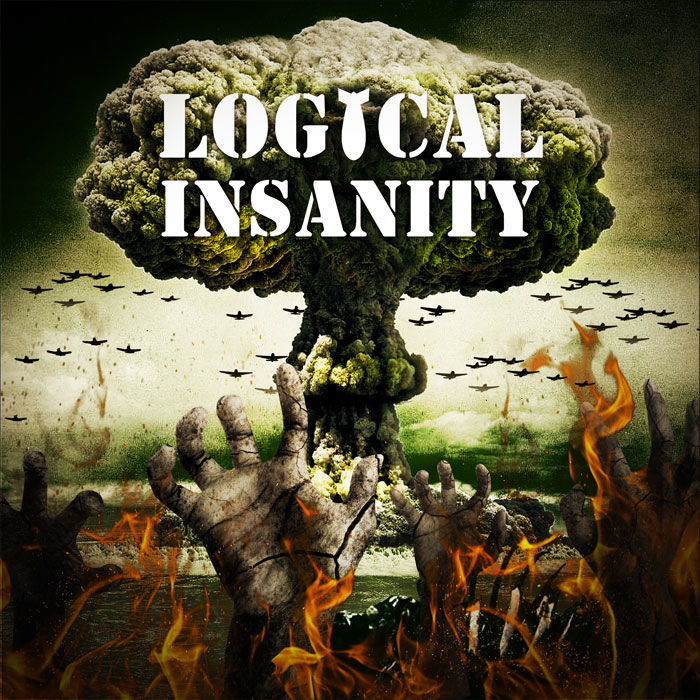
Esslin tells us that one aspect of absurdism is that “it castigates, satirically, the absurdity of lives lived unaware and unconscious of ultimate reality.” A search for ultimate reality sounds a lot like religion minus all the magic stuff, particularly back then in the late Sixties, when traditional religion was fading, ill-equipped for the times. After all, these ideas represents a return to the original purpose of theatre, to grapple with the Gods.
Theatre of the Absurd is not particularly interested in the conventional notions of character, motivation, exposition, backstory, plot, or dramatic arc, the pillars of traditional storytelling. It follows the rules of neither comedy nor tragedy, because it’s almost always both, like real life. Absurdist theatre is expressionistic, conveying emotion and psychology, not relaying information or a message.
And that’s why it’s so appropriate for these befuddling times we live in (then and now), when we’ve lost faith (again) in all our institutions, and in our fellow humans, and in facts, and in language itself. The only honest theatre, the only honest storytelling must acknowledge all that. In this world stripped of certainties and rituals, the most ancient ritual of dramatic storytelling has to fill that void.
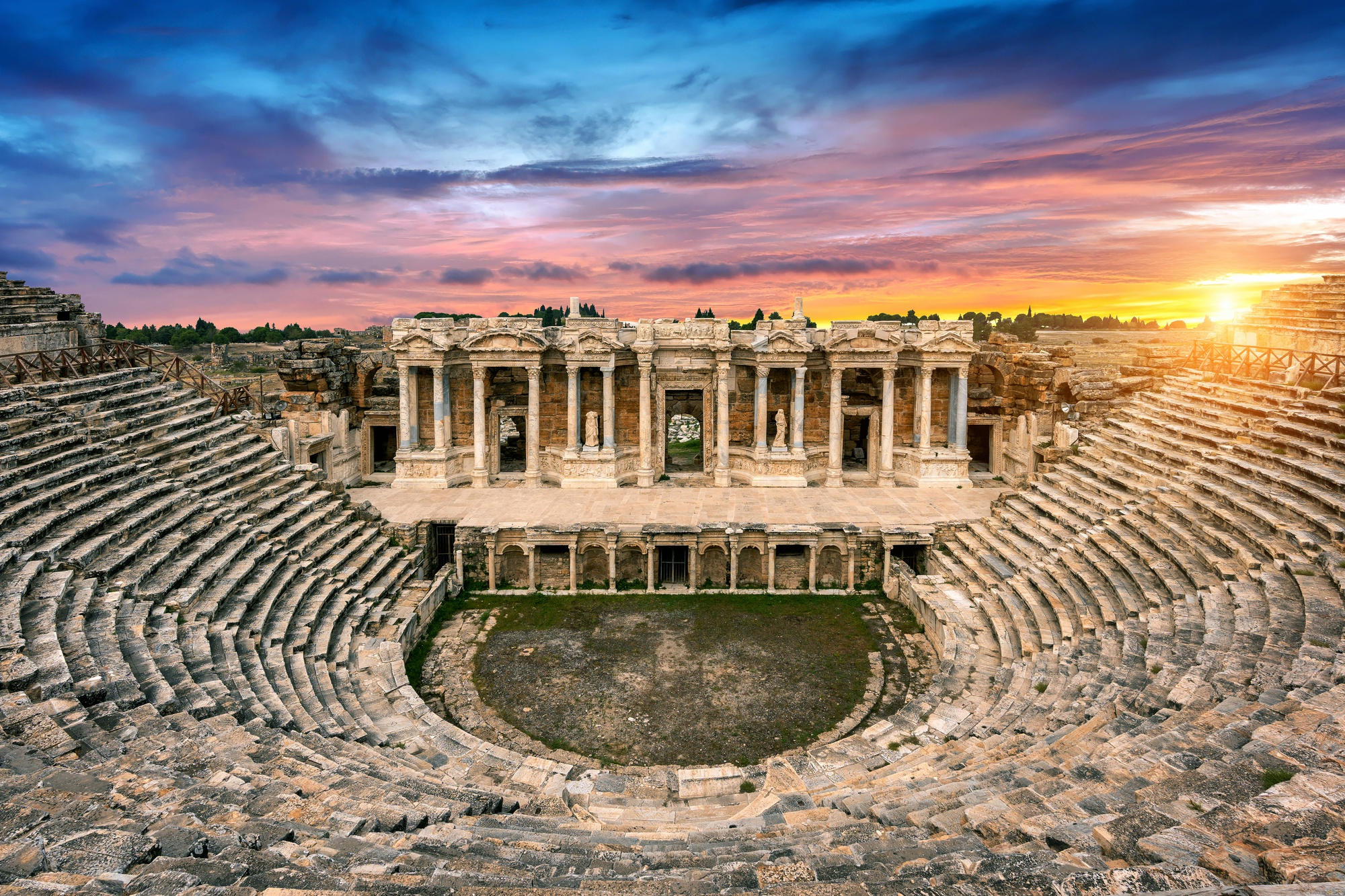
Ionesco said, “The aim of the avant-garde should be to rediscover – not invent – in their purest state the permanent forms and forgotten ideals of the theatre. We must cut through the cliches and break free from a hidebound ‘traditionalism;’ we must rediscover the one true and living tradition. . . To give the theatre its truest measure, which lies in going to excess, the words themselves must be stretched to their utmost limits, the language must be made almost to explode, or to destroy itself in its inability to contain its meaning.”
I love that so much.
In writing about America in 1961 – though he might be writing about now – Esslin says, “There is a kind of horror about, and I think that this horror and absurdity go together. . . If life in our time is basically absurd, then any dramatic representation of it that comes up with neat solutions and produces the illusion that it all ‘makes sense’ after all, is bound to contain an element of oversimplification, to suppress essential factors – and reality expurgated and oversimplified becomes make-believe.”

And sometimes tiny, harmless creatures can look like terrifying monsters under a magnifying glass. Now that I think about it, that's about as apt a metaphor as I've heard to describe Promenade. Although to be honest, Promenade is more like a magnifying glass combined with a funhouse mirror.
It's a hell of a ride. You will love it. The adventure continues...
Long Live the Musical!
Scott
P.S. To get your tickets for Promenade, click here.
P.P.S. To check out my newest musical theatre books, click here.
P.P.P.S. To donate to New Line Theatre, click here.



0 comments:
Post a Comment